
Kia Motors has unveiled a new logo as it enters the year of transformation with the Plan S long-term strategy. The company has also changed its slogan to ‘Movement that inspires’. The Kia KY MPV arriving next year would be the first ‘new’ Kia car in India to feature the updated slogan and logo. It gets a minimalist design, and resembles a handwritten signature with an unbroken line forming the lettering.

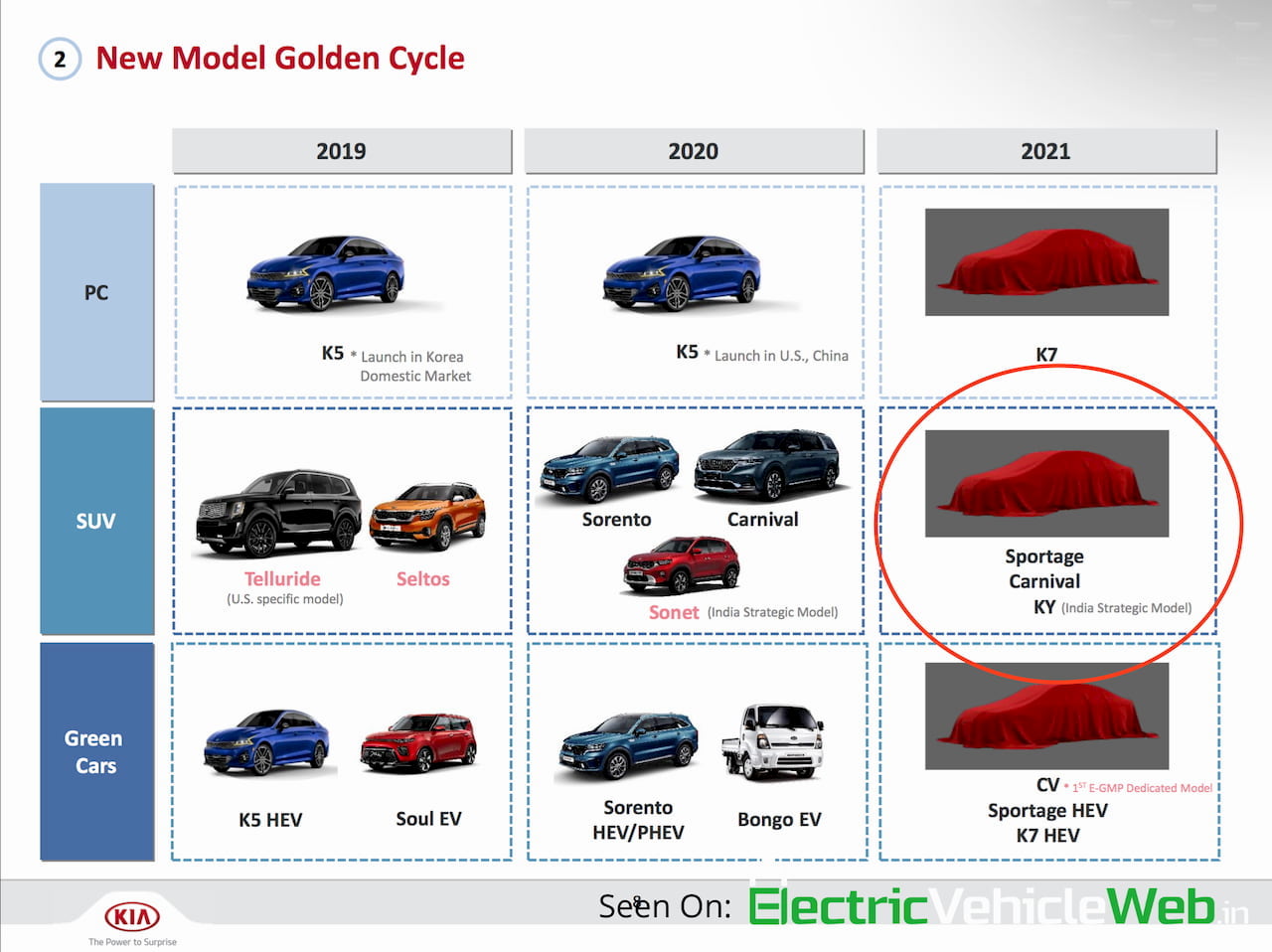
It was just last week that ElectricVehicleWeb.in revealed that the Kia compact MPV that is being developed for India is codenamed ‘Kia KY’. The new Kia MPV for India (represented in the display image) would be launched in January 2022, as per an official Kia Motors document EVW accessed.
Kia has been launching locally manufactured models in India since its entry in 2019 to grow the brand, and it plans to continue that strategy as the country is now regarded a new volume growth driver. The company is working on a second strategic model (after the Kia Sonet) designed mainly for India, and it’s an MPV internally designated the codename ‘KY’.
The Kia KY MPV would be a compact 7-seater competing with variants of the Maruti Ertiga, Toyota Innova Crysta, and the Mahindra Marazzo. While we don’t have its name, a poll conducted by the company in 2018 found Kia Trazor and Kia Tusker popular among the Indian audience. Like with Seltos and Sonet, it would adopt a global name for the MPV and like the Carnival, expect an SUV-inspired exterior design on the people mover.
The Kia KY MPV would ride on the same platform as the Kia Seltos (Kia SP2) and the second-gen Hyundai Creta (Hyundai SU2). There is a possibility that it turns out to be a sister model of the Hyundai MPV for Indonesia that is rumoured to be called Hyundai Staria and scheduled to enter production in the second half of this year. Hyundai is taking the SUV route to realize its premium 7-seater ambition, and the launch is due this year.
The new Kia MPV for India is likely to share powertrains with the Kia Seltos, which is available with a 1.5-litre N/A MPI petrol engine (115 PS/144 Nm), a 1.4-litre turbocharged GDI petrol engine (140 PS/242 Nm) and a 1.5-litre turbocharged CRDi diesel engine (115 PS/250 Nm). The Kia KY at some stage its in lifecycle will come with a mild-hybrid system. The CAFE II (Corporate Average Fuel Economy) and RDE (Real Driving Emission) norms effective from 2022 compel automakers to electrify cars. Mild-hybrid technology is seen as the cost-effective solution at large for the regulatory compliance.
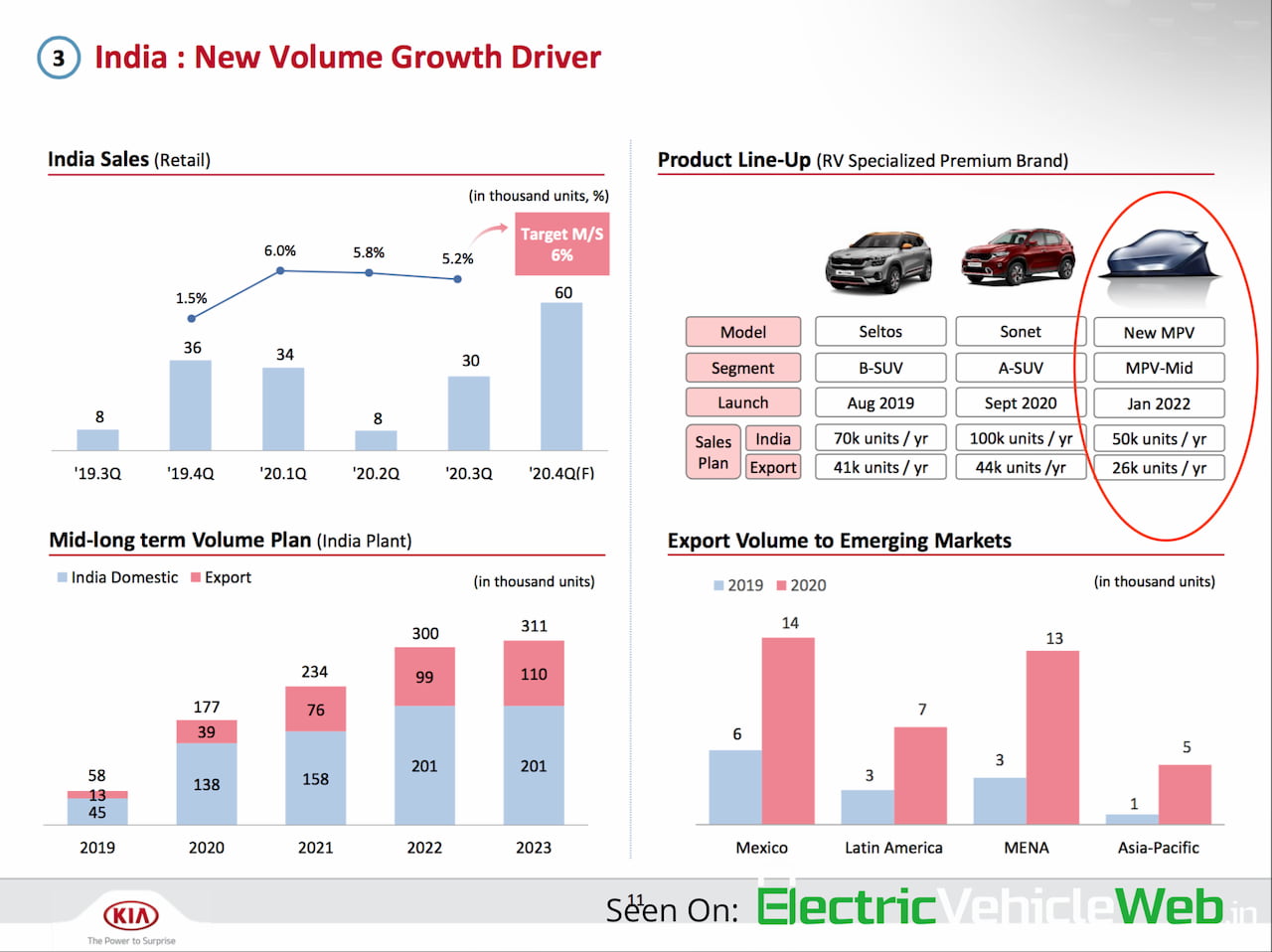
The Kia KY MPV would slot below the third-gen Kia Carnival (Kia YP) and will be manufactured at the Anantapur factory. The company has set an annual sales target of 76,000 units for this model, 50,000 units of which would go to Indian customers. The remaining would be allocated to export markets, which would be mostly or only emerging countries where the Maruti/Suzuki Ertiga, Mitsubishi Xpander and the Toyota Avanza are dominant.
The Kia KY MPV’s price in India could start around INR 11 lakh (ex-showroom Delhi). The Mahindra Marazzo and Toyota Innova Crysta are priced starting at INR 11.25 lakh (ex-showroom Delhi) and INR 16.26 lakh (ex-showroom Delhi) respectively.

![Kia EV5 & five other dedicated Kia EVs are expected by 2026 [Update]](https://electricvehicleweb.com/wp-content/uploads/2021/04/Kia-EV-product-pipeline-roadmap-350x197.jpg)